DIU Academic Analytics Platform
Deterministic Credit-Weighted Analytics & Student Academic Planning
A cloud-backed academic planning platform with authenticated records, credit-weighted GPA analytics, goal-feasibility calculations, and interactive reporting.
Application Interface & Live Telemetry
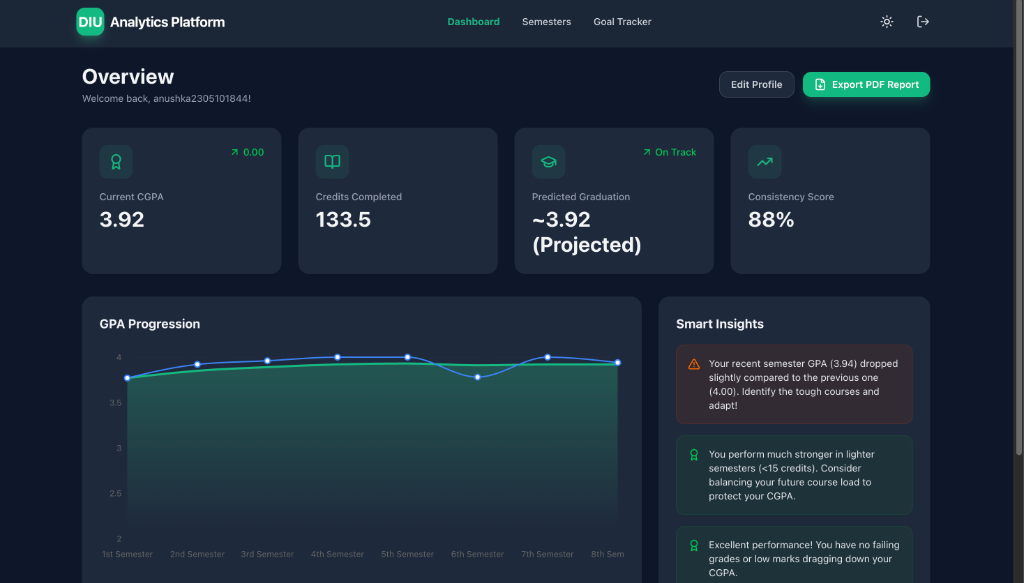
Genuine interface screenshot captured from the deployed DIU Academic Analytics Platform codebase.
Problem & Context
University student portals typically display past grades without providing forward-looking scenario modeling or degree planning calculators. Students frequently miscalculate credit-weighted impact when planning retakes or upcoming semester course loads.
Built to address student academic planning needs at Daffodil International University, transforming manual grade calculations into a modern, cloud-synchronized web application.
Role & Contributions
Sole Architect & Full-Stack Developer. Conceived the feature set, designed UI workflows, implemented calculation logic and state persistence, and deployed to production.
- Deterministic credit-hour weighted CGPA calculations
- Goal-feasibility scenario solver (calculating required GPA per remaining credit)
- User authentication and cloud record synchronization
- Responsive dashboard with Recharts visual trend analysis
Architecture & Engineering Decisions
A client-side rendered Single Page Application (SPA) backed by Firebase Authentication and Firestore data synchronization.

Architecture Overview: DIU Academic Analytics deterministic credit-weighted projection engine and multi-semester scenario planner.
- 1.State Store (Zustand): Centralized store managing semester records, course credits, grade points, and target CGPA settings.
- 2.Calculation Engine: Pure deterministic TypeScript functions computing cumulative GPA, earned credits, and required semester target averages.
- 3.Visualization Layer: Interactive semester-by-semester GPA trends and credit distribution charts using Recharts.
- 4.Cloud Sync: User-authenticated data persistence with offline cache support.
Decision Log & Trade-offs
Rationale: Academic grading is strictly deterministic governed by credit-weighted arithmetic. Using machine learning would introduce unnecessary error into degree planning.
Trade-off: Focuses purely on rule-based projection rather than predictive difficulty scoring.
Rationale: Zustand provided minimal boilerplate, clean TypeScript typing, and fast local persistence hooks without complex boilerplate.
Trade-off: Slightly smaller ecosystem of pre-built devtool extensions.
Experimental Methodology & Evaluation
Validated against DIU university grading policies and credit weighting formulas across 12-semester degree plans.
Evaluation Metrics & Targets
Live in production and used by peer undergraduate students for degree planning.
Implemented and Verified Capabilities
- Deployed a reliable, production-ready platform with zero server runtime maintenance overhead.
- Empowered students to simulate scenarios (e.g., target GPA requirements over remaining semesters).
- Demonstrated solid full-stack engineering, clean UI architecture, and robust state management.
Limitations & Scope Constraints
Scientific Boundaries & Future Scope:
- •Currently tailored to DIU standard 4.00 grading scales; multi-institution scale customization is a planned extension.
- •Requires manual entry of past courses in the absence of direct university SIS API access.