ResiliNet
Explainable ML-Assisted SDN Digital Twin & Predictive Routing
An explainable ML-assisted SDN digital twin for link-congestion forecasting, policy-aware OpenFlow routing, and reproducible Mininet experiments.
Application Interface & Live Telemetry
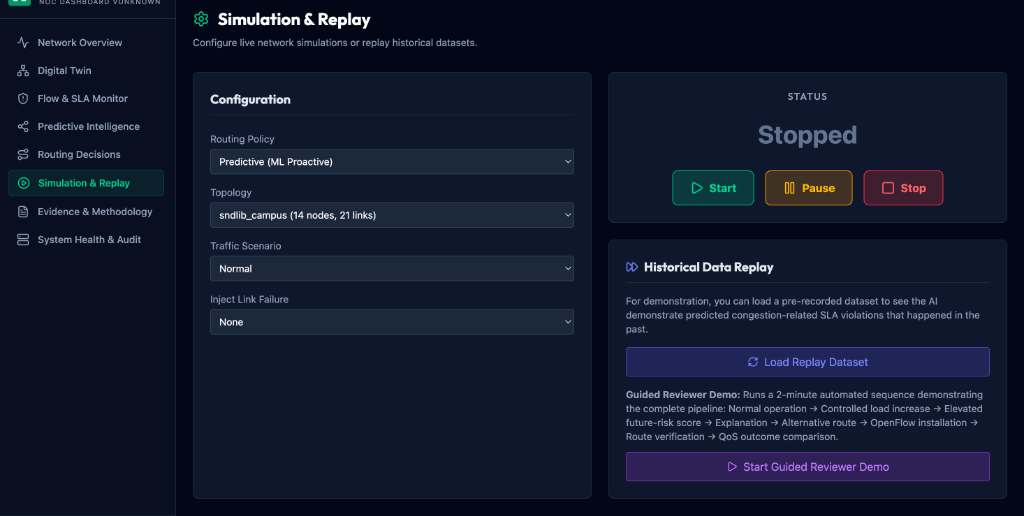
Genuine interface screenshot captured from the deployed ResiliNet codebase.
Problem & Context
In software-defined networks, conventional routing algorithms react to link congestion only after packet loss and latency spikes have degraded traffic quality. In addition, black-box machine learning models for traffic steering lack transparency, making it difficult for network operators to interpret automated decisions.
Developed as an academic research prototype investigating the combination of SDN telemetry, machine learning risk forecasting, and explainable decision support with reproducible artifact tracking.
Role & Contributions
Project Creator & Lead Developer. Formulated the digital twin architecture, implemented telemetry collection and feature engineering pipelines, integrated the LightGBM classifier, formatted TreeSHAP local explanations, and built the FastAPI control endpoints.
- 61 automated backend tests and 11 frontend tests
- Three controlled routing policies: static/no-reroute, reactive-threshold, and predictive-ML
- Four seed-controlled Mininet scenarios: normal operation, gradual congestion, sudden traffic surge, and concurrent service-class flows
- SHA-256 experiment run provenance tracking and artifact validation
Architecture & Engineering Decisions
ResiliNet couples a simulated/emulated SDN data plane with an asynchronous machine learning inference service and an operator dashboard.

Architecture Overview: ResiliNet SDN emulation topology, rolling telemetry ingestion, LightGBM risk classifier, and TreeSHAP attribution pipeline.
- 1.Data Plane Emulation: Mininet topology with OpenFlow switches managed through the Ryu SDN controller.
- 2.Telemetry Collector: Periodic port-stats polling computing link utilization, packet delta, and queue depth.
- 3.Predictive Inference Pipeline: LightGBM classifier estimating short-horizon link-congestion risk from rolling telemetry features.
- 4.Explainability Engine: TreeSHAP local feature attribution decomposing the influence of port counters, burst history, and utilization deltas.
- 5.Policy Engine: Three controlled routing baselines (static/no-reroute, reactive-threshold, and predictive-ML).
- 6.Provenance & Artifact Logger: Run parameters, model configurations, and telemetry logs recorded with SHA-256 hashes for reproducibility.
Decision Log & Trade-offs
Rationale: LightGBM was selected for compatibility with structured rolling-window telemetry, efficient inference, and direct support for TreeSHAP local explanations.
Trade-off: Requires manual feature engineering of rolling windows rather than automated sequence representation.
Rationale: TreeSHAP computes exact Shapley values with mathematical consistency on tree ensembles, providing per-flow feature attribution without stochastic sampling variance.
Trade-off: Tied directly to tree-based estimators.
Rationale: If model risk scores fall below confidence thresholds or telemetry is unavailable, routing deterministically falls back to standard shortest-path without interrupting active flows.
Trade-off: Requires continuous health monitoring of the inference service.
Experimental Methodology & Evaluation
Constructed four seed-controlled Mininet experimental scenarios: normal operation (steady background traffic), gradual congestion (incremental load ramp), sudden traffic surge (burst injection), and concurrent service-class flows. Verified execution workflows with automated test fixtures.
Evaluation Metrics & Targets
Automated test suites verify route computation, fallback behavior, SHAP vector formatting, and telemetry serialization.
Implemented and Verified Capabilities
- Implemented an end-to-end telemetry, prediction, explanation, and routing architecture.
- Verified system behavior through automated backend and frontend test suites.
- Implemented reproducible campaign orchestration, artifact validation, and statistical evaluation pipelines.
- Completed mock campaign runs for pipeline verification; real comparative Mininet performance benchmark remains pending.
Limitations & Scope Constraints
Scientific Boundaries & Future Scope:
- •The real comparative Mininet emulation campaign has not yet been published; physical-network and hardware-testbed validation remain future work.
- •Current model assumes a fixed topology; dynamic topology discovery and online model adaptation are areas for future research.